Archives for category: Uncategorized

IMG_0571.PNG
At eight months post-partum ( + post-surgery + post-illness), my body is pretty much back to its steady state. There are some enduring changes: scars, loose skin. I’m thankful for my Cesarean scar as a permanent reminder of my son’s presence in my body, especially as the more transient reminders drift away. I had a very dark, thick, adorable linea nigra. I thought it might last forever, but it’s started to fade over the past three weeks.

After a lot of painful work to loosen and soften my big, deep scar, I can finally hold a plank without pain at my incision (except when my bladder is full, and except when I have menstrual cramps). After countless wonderful but strenuous physical therapy sessions, massages and yoga classes, my normal posture is back.

At times that progress and recovery is exciting. I feel more powerful and physically present. Sometimes, that inspires a bit of hope and optimism.

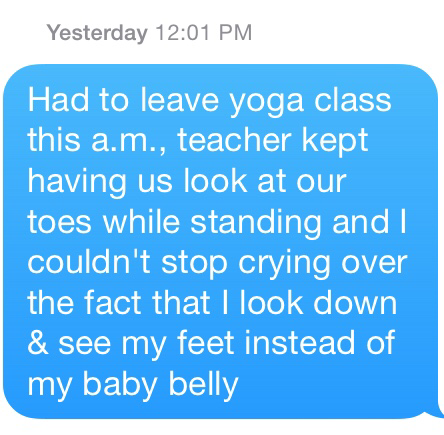
In some moments, though, living in this babyless body breaks my heart open all over again.
October is Pregnancy and Infant Loss Awareness Month.

(Why always “loss”? Maybe it’s an effort to avoid the annoying etymology surrounding intrauterine death… but my son was not “lost”, he horrifically bled to death, and I’m lucky that I didn’t also die in the process…)

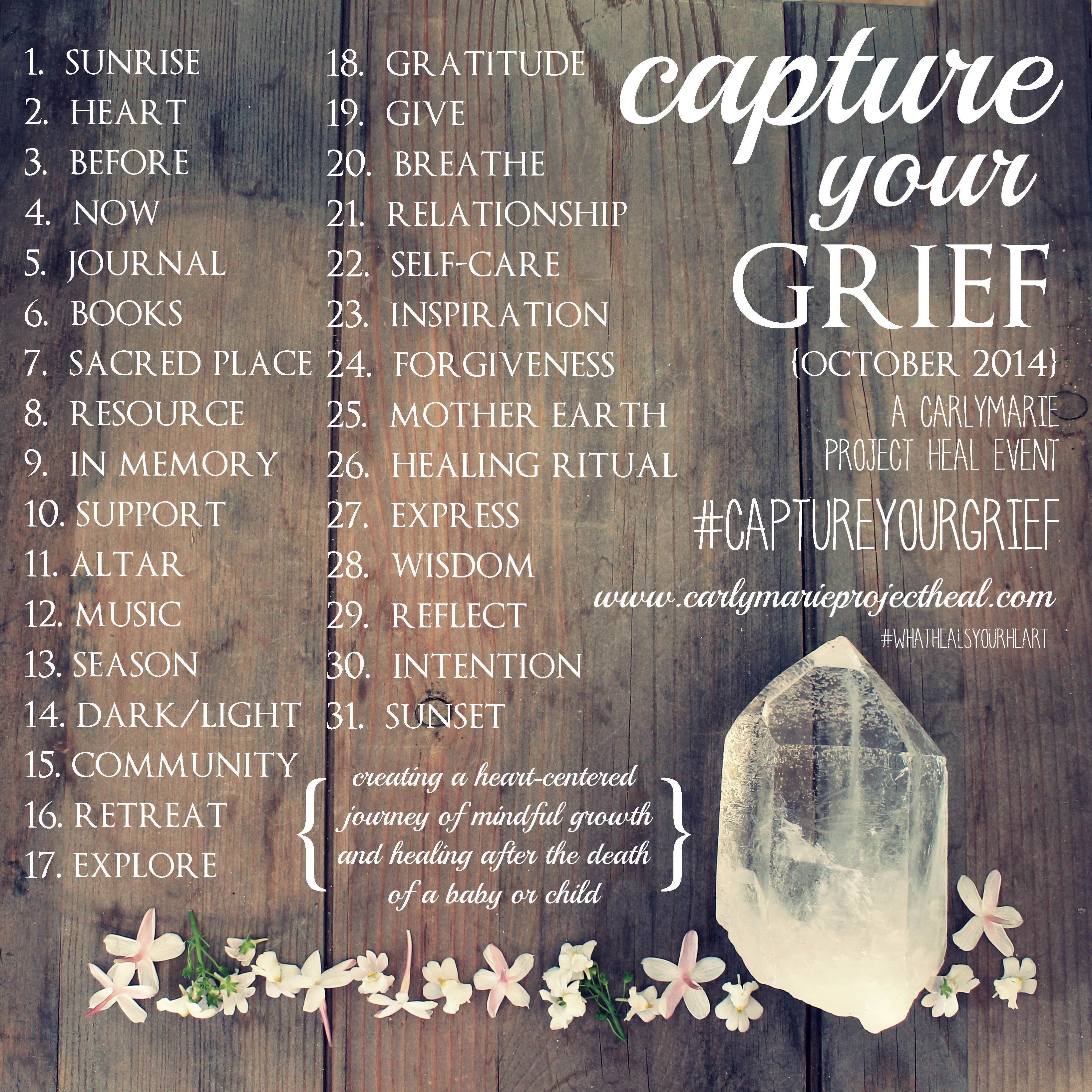
Anyhow, as I was saying, October is Pregnancy and Infant Loss Awareness Month. In the online community of mothers who have lost their babies, many are participating in a daily post challenge.

cAPTUREyOURgRIEF20142

I appreciate the beautiful things that other people are creating. And I don’t want to be a non-joiner (I’m an enthusiastic “joiner” by nature, though I opt out of countless things in real life these days).

But the truth is, I’m not at a point where I want or need to do something like that yet. I can’t look back at what I’ve been through yet, because I’m still “in it”. I have enough overflowing thoughts and feelings that I don’t need a daily inspiration. And I have enough angst that I’m not interested in a “heart-centered journey of mindful growth and healing”. Not this month, at least. Not today.

Maybe I could put a bow on my sadness. But I’m facing so many things, from fear and anger to abandonment and betrayal, from shattered assumptions to shattered identity. As this awesome review article on perinatal loss explains, “grief may account for as little as 20% of postloss depression”. I’m not necessarily depressed, actually, but I am going through a huge series of unchosen, confusing adjustments in every single area of my life. And I’m not in a good place for a post challenge.

Maybe next year. Or maybe in five years. Not right now.

I relate so well to this post right now. I feel like a “shrunken sweater” in most aspects of my life: as a mother, a woman, a person who got married, a person who is single, a resident, a professional (formerly?) interested in public health and preventive medicine and obstetrics and all sorts of things that seem silly and impossible today.

This is difficult to cope with. It’s an existential crisis. I have to get a little philosophical to survive each day. I have to remember that even though my external identities and roles are under constant challenge, my actual self is just as safe and solid as it ever was.

In yoga, a person’s essence isn’t their body, or their mind, or any of the things they do. Those are just external trappings. The real essence or identity is the non-material, eternal spark of life. That essence can’t be modified or injured. Even though it’s often forgotten and ignored, it never leaves or changes.

Or as James Marsden put it on Modern Family…
Cameron: You’re living in our daughter’s princess castle?
Barry: No, don’t be ridiculous.
[Points at heart] I’m living in here.
[Points at castle] I’m sleeping in there.

T's avatarC is for Crocodile

The majority of my friends, both online and in real life, are parents. This was fairly intentional. I became a part of a vibrant lesbian blogging community when I was trying to get pregnant with Caemon because the support through that process was so important. In fact, with each stage of becoming a parent and then being a parent, surrounding oneself in one’s tribe is the smart thing to do. New parents need to be able to talk about new parent things to ask new parent questions and complain new parent complaints. These communities of parent friends, both online and in real life, were an essential piece in helping us maintain our sanity through Caemon’s illness and in keeping us afloat after his passing. After all, who could better understand the fear or pain of losing a child than those who know the way that parenting bursts the heart open…

View original post 1,023 more words

IMG_0507
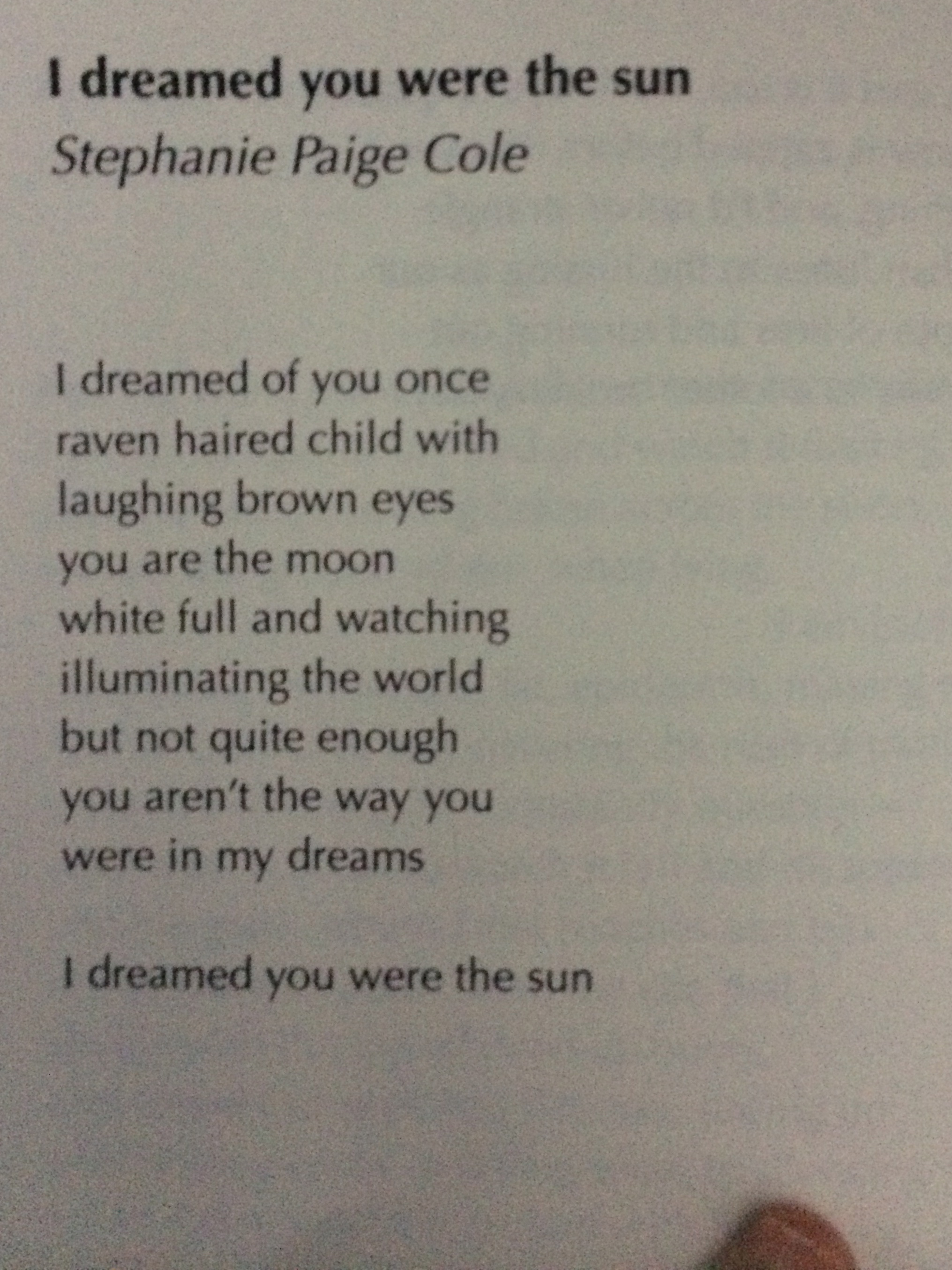
This poem came to me at exactly the right time.

I was at JFK on my birthday, eating alone in between flights, so upset after receiving dozens of well-meaning messages encouraging me to “have a happy birthday”.

Read the rest of this entry »

For the first weeks after Sacha died, I was drawn to the “information for fathers” sections of baby-loss books (which, by the way, have absurd names to match the absurdity of the situation: “Empty Cradle Broken Heart”, “When Hello Means Goodbye”, :We Were Gonna Have a Baby But We Had an Angel Instead”, “I’ll Hold You in Heaven”… you can’t make this stuff up!). I needed to be told what women are assumed to already know: that I was allowed to have feelings, acknowledge those feelings and even express them.

Days before, I’d been stepping into the role of single mom. I was choosing a new apartment, plotting daycare strategies, recruiting community support and getting my will notarized. Every one of my molecules was focused toward caring for, protecting and raising my son (as I watched the winter Olympics, all I could think about was the relative danger of each sport; I would teach Sacha to ski and ice skate, I decided, but ski jumping and speed skating were out of the question). And just to make sure that stress didn’t impact the baby, I was also meditating several times a day, listening to calming music, journaling, basically doing everything possible to keep me and my kiddo from simmering in stress hormones. It all worked, we were so happy.

Then in a matter of hours, the welcomed tasks of parenting disappeared and were replaced by the very different, unexpected, unwanted tasks of grieving. I was crippled by self-consciousness. I knew that I needed to work through the grief, but I had no idea what that really meant (if it sounds like I was detached about the whole thing, that’s because I was; it’s called shock… who knew!).

I felt vulnerable and exposed, and I was afraid that others would judge and analyze how I was acting. Seeing other animals mourning brought me a lot of comfort. I learned that grief is natural and inevitable. It’s so fundamental that the necessary emotions are beyond logic or judgement. As a good friend said to me, “grief is grief, it’s different for everyone and it just happens”. I also saw that, because of very poor logistics and my own physical state, I had missed out on a lot of the experiences that are natural for a grieving parent to engage in. That gave me the very helpful opportunity to mourn for the loss of those experiences as well. Links to some of my favorite pictures and videos after the jump. Read the rest of this entry »

Why write about these painful experiences?

How many books about the experience of warfare were you required to read in high school? How many books about the experience of pregnancy and childbirth? And yet, which experience is more common? How many classmates went on to the military, and how many went on to become pregnant?

As a society, we have an incredibly poor understanding of what reproduction entails for females.

Pregnancy is dangerous, and so is childbirth. The experiences are physically and psychologically challenging, even in the best of circumstances. All mothers take on great physical risk for their children – the risk of pain and surgery, the risk of blood clots and hypertensive disorders, hemorrhage, infection, chronic bodily dysfunction, scaring, more pain, death. The risk of loss of independence and income, sometimes loss of safety and self-reliance. In some places, the risk of criminal charges and imprisonment.

Mothers bravely take on these risks. They learn to walk differently and use the bathroom differently, to lie down and roll over differently. They learn to stand strong in the midst of judgement and, often, harassment. To accept another body as a part of their own body. To accept indescribable pain. They learn to lie on their backs and say “okay, pick up that knife, I have to trust you, cut me open”.

But childbirth is common, and some of the mechanics are involuntary. Therefore, it’s often thought of as the most banal thing in the world. It isn’t. It’s a heroic act of bravery.

(Inspired by Dr. Kimberly Theidon who documented the years of atrocity and heroics endured by Sacha’s family in Peru, and who continues to stand up for the validity of women’s experiences)

“Anyway, I keep picturing all these little kids playing some game in this big field of rye and all. Thousands of little kids, and nobody’s around – nobody big, I mean – except me. And I’m standing on the edge of some crazy cliff. What I have to do, I have to catch everybody if they start to go over the cliff – I mean if they’re running and they don’t look where they’re going I have to come out from somewhere and catch them. That’s all I do all day. I’d just be the catcher in the rye and all. I know it’s crazy, but that’s the only thing I’d really like to be.”
~ J. D. Salinger, The Catcher in the Rye

Read the rest of this entry »

Please excuse a bit of Virgo navel-gazing! After surgery, I joked about my frustration that I couldn’t just experience my physical pain, I had to abstract it into metapain. Then I realized my labor had been more of a metalabor, my son’s NICU stay a metahospitalization. There was no metadeath or metagrief. But now, there is metablogging.

I’m back home after a week away, and trying to get back into a routine. I want to post something, but I’m conflicted, as always, about whether to post something rawer about the fresh things I’m working through (there’s no end of things for me to work through!), or whether to dredge something up that shows where I’ve been.

Read the rest of this entry »

In the spring, someone told me that it’s helpful to come up with a descriptive concept to represent the grief experience. Many people say that grief is “like being rocked by waves”. I half-heartedly accepted the wave theory (the emotions of grief do come in unexpected, overwhelming bouts), but it felt a little off. Eventually my own description took shape.

It was as though I had been newly blinded, and placed alone in an unfamiliar room. I couldn’t see what was before my face. With each movement there was a risk of unexpectedly stubbing my toe on the furniture, or worse: knocking over boxes, banging my head on the chandelier, stepping on shattered glass. Occasionally I found a safe and quiet space to rest. The work of constructing a mental map began. But the map was unreliable, based on fearful memories and incomplete knowledge. And it was unrecorded, the lines held imprecisely by a tired mind.

During those days, others often worried that I would become bored. But I’d never been busier, had never worked harder, was never so exhausted. I was dodging table legs and feeling my way along the side-walls. I was building my map. Constantly bruised and cut, recovering from various wounds while sustaining new ones. That was the work of grief.

With time my map improved, and I could even rearrange things. Put a big couch in the center, swept up most of the glass, reminded myself to keep away from that gross sticky patch near the corner. I didn’t want to be in that room, but it had become my home.

Now I have that safe place to call my own, but I’ve realized that the entire house is unfamiliar. There are many more rooms to explore and make safe. Some day I’ll need to go outside to make sure the structure seems stable. But not yet; I still haven’t cleared a path to the door.

In medical settings, people generally assume that I’m very young and that I have little personal life experience. Maybe it’s my baby face. Maybe it’s the fact that medical training is so time-consuming that often doctors don’t pursue a personal life outside of their career until they are older. Maybe it’s the fact that we devalue individual experiences, knowing that “an n of one” should not drive decisions. Or, maybe it’s the fact that our work conditions are so frequently inhumane, and the work itself is often dehumanizing (of course, those characteristics aren’t unique to medicine).

At any rate, my significant personal life has always come as a welcome surprise to patients and a bit of a curiosity to older physicians. That my personal life could include hardship and sadness — the possibility doesn’t cross anyone’s mind. I don’t intend to shock people, but my experience is shocking. Keeping quiet about the experience makes me feel sad and stifled, as though my atypical hardship were shameful, when nothing could be further from the truth. Medicine failed my child and me, not the other way around.

I’m still not sure where my story belongs. Or where I belong. So I’m having lots of conversations like the following.

Kindly Hospice Attending (initiating an educational conversation with me while he completed a death note for a patient who had just passed): “How do you diagnose death?”

Good Resident Kaitlyn: “Well, it depends on the case… Read the rest of this entry »